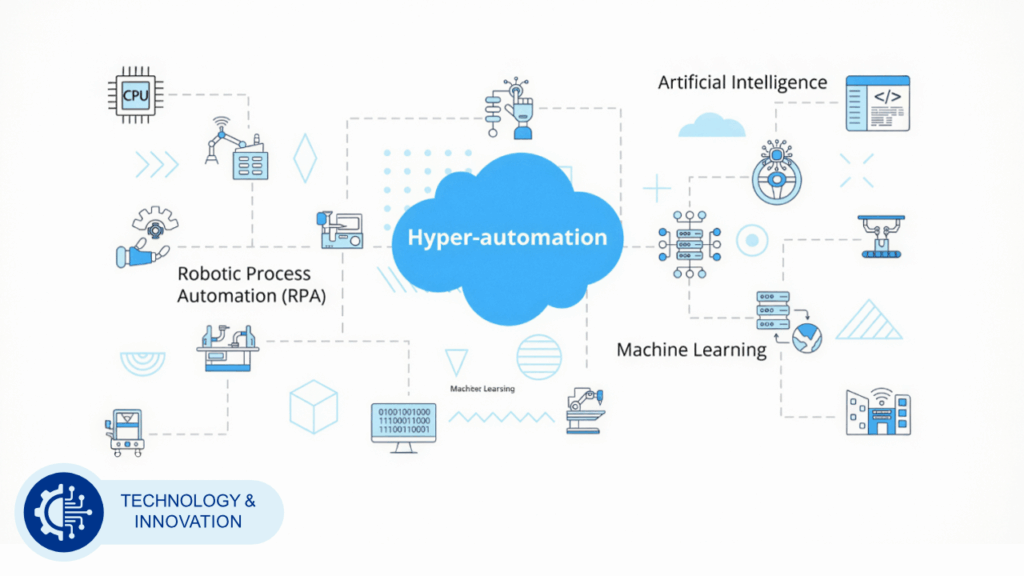
In the world of automation, Robotic Process Automation (RPA) has been a gamechanger, helping businesses streamline repetitive tasks and boost productivity. But as digital transformation accelerates, organizations are looking for more. Enter hyper automation, a next-level approach that combines RPA with advanced technologies like AI, machine learning, process mining, and data analytics to deliver smarter, more dynamic workflows.

So, what makes hyper automation different?
What is Hyper automation?
Hyper automation goes beyond automating individual tasks. It aims to automate entire end-to-end workflows, bringing intelligence to the automation process. Think of it as a more strategic, data-driven approach to automation – one that not only executes tasks but also adapts, learns, and improves over time.
What Makes Hyper Automation Different?
While RPA focuses on automating individual, repetitive tasks, hyper automation aims to automate entire business processes. It introduces intelligence and adaptability, creating workflows that not only execute tasks but also improve and evolve over time.
This shift transforms automation into a dynamic, self-optimizing system that delivers value across the organization.
Key Features of Hyper automation
1. Comprehensive Automation
Hyper automation doesn’t stop at simple tasks – it connects entire workflows, integrating cross-functional processes to create seamless operations. For example, automating customer service could involve NLP-based chatbots, RPA bots for ticket creation, and analytics for customer behavior insights.
2. AI-Driven Decision Making
By leveraging AI and machine learning, hyper automation enables systems to analyze data, predict trends, and make decisions autonomously. It’s not just about executing commands – it’s about understanding context and acting intelligently.
3. Unstructured Data Handling
Traditional RPA struggles with unstructured data like emails or scanned documents. Hyper automation integrates technologies like OCR and NLP, making it possible to process and utilize this data efficiently.
4. Continuous Process Discovery
Tools like process mining and task mining are essential in hyper automation. They identify inefficiencies and highlight new opportunities for automation, ensuring businesses stay ahead of the curve.
5. Real-Time Adaptability
Hyper automation systems can adjust dynamically based on real-time data. For instance, supply chain systems can adapt to sudden changes in demand or disruptions without manual intervention.
Key Technologies Driving Hyper automation
Hyper automation builds on the foundation of RPA by integrating:
- AI & Machine Learning: To handle unstructured data, predict outcomes, and enable decision-making.
- Process Mining: To identify inefficiencies and discover automation opportunities.
- Natural Language Processing (NLP): For tasks involving text or speech, like customer interactions.
- Analytics: To provide insights and drive continuous optimization.
Together, these technologies create a seamless automation ecosystem that evolves with your business.

Why is Hyper automation Important?
In today’s competitive landscape, hyper automation offers several critical benefits:
- End-to-End Efficiency: Automating entire workflows boosts productivity across departments.
- Flexibility: Adaptive systems respond to changing business needs or market conditions.
- Cost Reduction: By eliminating inefficiencies, organizations save both time and money.
- Smarter Decision-Making: With real-time data insights, businesses can act faster and more accurately.
The Growing Impact of Hyper automation
Hyper automation isn’t limited to a single function or department. It’s reshaping entire industries by enhancing flexibility, scalability, and intelligence. Here are some impactful applications:
1. Customer Experience Transformation
Hyper automation creates personalized, efficient customer journeys by integrating AI chatbots, CRM systems, and analytics. Businesses can anticipate customer needs and respond proactively.
2. Streamlining Compliance
In highly regulated industries, hyper automation can continuously monitor compliance requirements, flag potential issues and reducing risk.
3. Employee Empowerment
Automation frees employees from mundane tasks, allowing them to focus on strategic, creative, or problem-solving work. Hyper automation also enables better decision-making through advanced data insights.
4. IT and DevOps Efficiency
Hyper automation can automate routine IT tasks like system monitoring, patch management, and incident response. By doing so, it minimizes downtime and improves system reliability.
5. End-to-End Digital Transformation
For organizations embarking on digital transformation, hyper automation is the backbone. It integrates legacy systems, automates core processes, and enables seamless collaboration between technologies.
Real-World Examples
- Finance: Automating fraud detection and compliance processes using RPA combined with AI models.
- Healthcare: Streamlining patient onboarding, scheduling, and insurance claim processing with integrated systems.
- Supply Chain: Predicting demand and optimizing inventory management using predictive analytics and machine learning.
The Challenges
While hyper automation offers immense promise, there are challenges:
- Integration Complexity: Combining RPA, AI, and other technologies requires robust planning and coordination.
- Skills Gap: Organizations need skilled professionals to manage and optimize hyper automation systems.
- Data Dependency: Quality and quantity of data significantly influence outcomes. Poor data can limit the effectiveness of automation.
- Change Management: Employees may resist new technologies. It’s crucial to align teams and foster a culture of innovation.
Implementing hyper automation isn’t without its hurdles. Businesses must tackle integration complexities, ensure data security, and invest in the right skills and infrastructure. However, the long-term gains – greater scalability, adaptability, and innovation – far outweigh the initial challenges.
The Future of Automation
As AI and machine learning evolve, hyper automation will become a cornerstone of modern business operations. It’s not just about doing things faster – it’s about doing them smarter. Organizations that embrace hyper automation will have a significant edge in driving growth, reducing costs, and staying ahead in an ever-changing digital landscape.