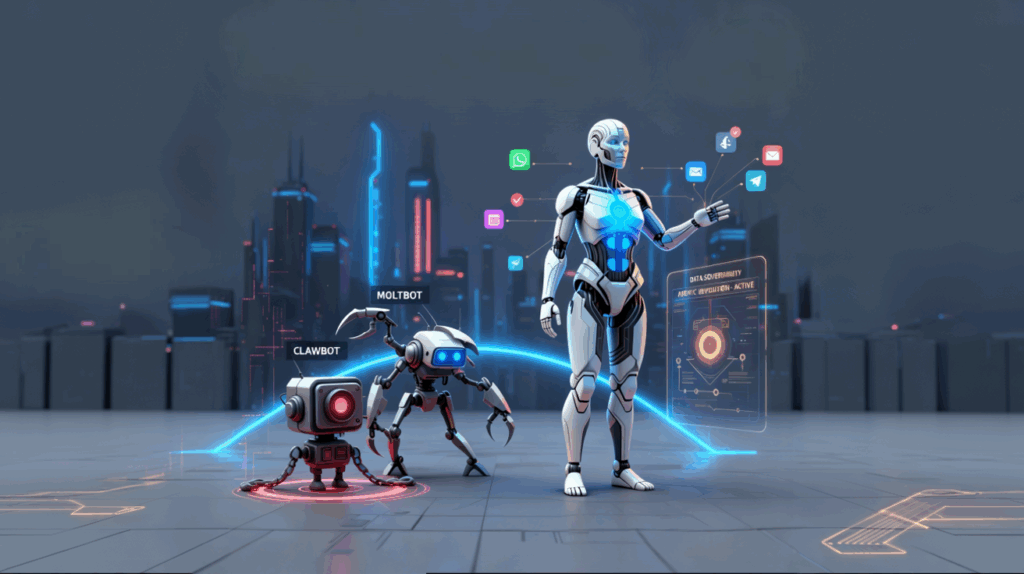
The AI industry has moved beyond the ‘Model Wars.’ The era where benchmark scores and parameter count defined leadership is over, superseded by the Era of Agency. Today, the competitive frontier for AI companies has shifted from mere intelligence to the power of autonomous action.
OpenClaw—the project that recently evolved from Clawdbot through its Moltbot phase—represents the vanguard of this move toward Data Sovereignty and Action-Oriented AI. Unlike traditional chatbots, it resides on the user’s local infrastructure and integrates directly into the existing communication fabric, such as WhatsApp, Slack, and Telegram. This architecture ensures that the AI’s “brain” remains local, processing intelligence exactly where the data resides.
The Context: From Chatbots to Autonomous Agents
The AI landscape has evolved beyond the limitations of the “Chatbot” interface. We have transitioned from reactive assistants to a new paradigm of Autonomous Agency. As an organization dedicated to the frontier of AI, we recognize that the future of this technology is “headless.” True utility is no longer found in a standalone chat window, but in an agent that operates as a background engine for productivity.
By refusing to lock users into a proprietary, “walled garden” application, OpenClaw meets users where they already work. This ensures total Data Sovereignty; the intelligence does not live in a distant cloud but remains within the user’s secure environment, ensuring sensitive data never leaves its intended habitat.
Strategic Decision Framework: Moltbot vs. Enterprise SaaS
For companies deciding how to integrate agentic workflows, the choice between open-source frameworks like Moltbot and “black-box” SaaS solutions like Zapier Central is a matter of strategic control.

For an AI-forward company, Moltbot offers the “Bring Your Own Key” (BYOK) model, which optimizes costs by paying only for raw API usage rather than bloated per-seat subscriptions.
Industrial Use Cases: Driving Efficiency at Scale
We see Moltbot’s architecture being deployed across sectors to handle the “plumbing” of modern business:
- Continuous Engineering: Automating the “boring” parts of the dev cycle—running unit tests, summarizing server logs, and opening pull requests via Slack.
- Operational Sentries: Monitoring high-stakes training jobs or financial markets and triggering autonomous interventions when specific thresholds are met.
- The Digital Twin: Acting as an executive partner that manages calendars, organizes local file systems, and bridges the gap between different software ecosystems.
The Critical Factor: Navigating the Security Paradox
No AI company can ignore the security implications of autonomous agents. There is an inherent trade-off: The more useful an agent is, the more system access it requires, and thus, the higher the risk.
- The Threat: Prompt Injection remains a primary concern. If an agent reads a malicious email or document, it could be “tricked” into executing unauthorized terminal commands.
- The Solution: We advocate for the “Molt” Strategy—isolating agentic instances within sandboxed environments (like Docker or dedicated hardware). This ensures that even an autonomous agent remains within its designated “guardrails.”
Conclusion: Defining the Future of Collaboration
Moltbot is a precursor to the AI Operating System. For companies in the AI domain, adopting or building upon these open frameworks isn’t just about efficiency; it’s about betting on a future where AI is integrated into the very foundation of our digital lives.
The winners of the Agentic Era won’t be those with the largest models, but those who build the most transparent, secure, and capable agents. We aren’t just building tools we command; we are building partners we can trust.