Most of us have sat through a fire drill, rolled our eyes at a “planned maintenance” email, or watched the IT team run some kind of failover test on a Tuesday afternoon. What we don’t always realize is that these moments aren’t just routine checkboxes — they’re part of something much bigger: keeping the organization alive when things go sideways.
Business continuity and disaster recovery aren’t concepts locked away in some IT department’s playbook. Every single person in an organization touches these practices in one way or another, whether they know it or not.
In the security world, BCP (Business Continuity Planning) and DR (Disaster Recovery) are what separate organizations that bounce back from those that don’t. You can have the best firewalls and the most sophisticated security tools money can buy, but without solid continuity plans, one unexpected incident — a power outage, a ransomware attack, a natural disaster — can bring everything to a halt.
So how do organizations get this right? Most look to ISO standards for guidance. ISO 27001 is one you’ve probably heard of — it’s a widely recognized framework that ties together various security controls to protect data and systems. But when it comes to continuity specifically, the standard that matters most is ISO 22301.
ISO 22301 is the international standard for Business Continuity Management Systems (BCMS). It gives organizations a practical roadmap: how to spot threats before they become crises, how to protect the functions that can’t go down, and how to keep things running — or get them running again — when something goes wrong. It’s not just theory. It’s a hands-on framework built from hard lessons learned across industries.
Closely related is ISO 27031, which narrows the focus to IT disaster recovery, making sure that technology systems recover in a way that actually supports the broader business — not just the tech team’s priorities. And within ISO 27001, two controls worth knowing are:
- A.5.29 — covers information security during a disruption, and
- A.5.30 — addresses ICT readiness for business continuity.
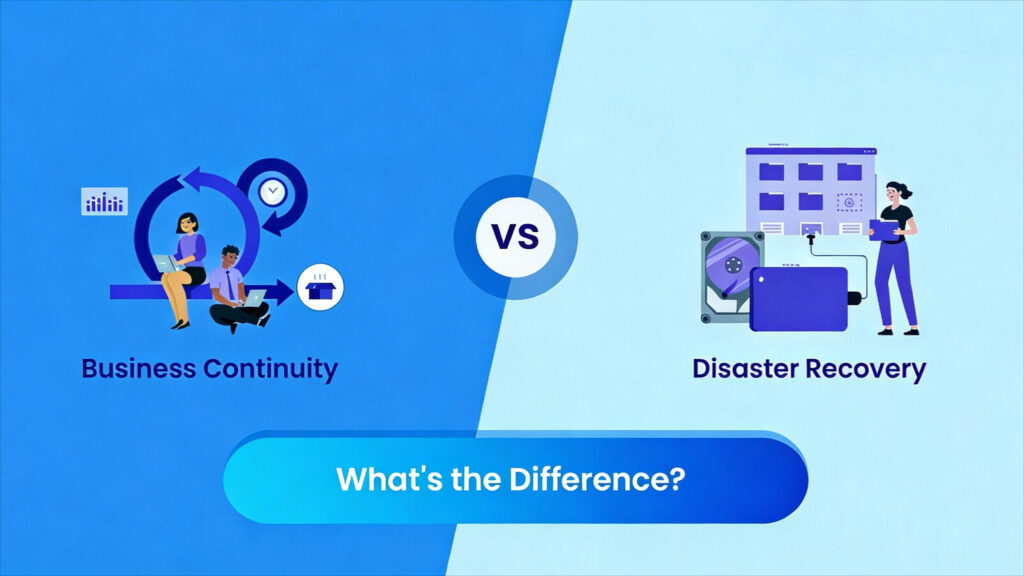
Here’s a simple way to think about the difference between BCP and DR: A Business Continuity Plan is the bigger picture — it’s the documented set of steps for how the organization keeps functioning after something goes wrong. Disaster Recovery zooms in on one piece of that: getting IT systems and data back online. Both matter. Both need each other.
When ISO 22301 brings them together under one framework, organizations gain real, measurable benefits:
- They become more resilient overall
- They reduce the risk of extended downtime
- They recover faster when incidents do happen
- They hold onto customer trust even through a rough patch
- They keep critical operations going, no matter what
The good news? You don’t need to be a security expert to play your part. When you participate in a fire drill, you’re practicing continuity. When you report a system issue instead of ignoring it, that’s continuity. When you follow data backup procedures or take that security awareness training seriously, you’re contributing to the organization’s ability to recover.
Security is a shared responsibility — and so is continuity. Staying aware and doing your part, even in the small things, adds up to an organization that can take a hit and keep going.