INTRODUCTION
The Japanese invented 5S, a methodology that made Just-in-Time production and Total Productive Maintenance management possible. Takashi Osada introduced the 5S methodology in the early 1980s since then it significantly increases the operational performance of organization. Sort, set in order, Shine, Standardize, and Sustain are the five S’s of lean management that are applied to the workplace. Everything ends with the improvement of the work process
CONTENT OF 5S MANAGEMENT

1) SEIRI (Sort)
To improve the production area, the first thing to do is to distinguish between what is needed and what is not needed. After a clear distinction, removing unnecessary items and handling
them properly can eliminate obstacles and make work easier. Usually, excess items, such as remaining raw materials and products, need to be modified or returned to the workplace. The disorderly placement of items also aggravated the narrowness of the original space. Therefore, evaluating necessary items related to cost or other related factors and defining areas with red tags to keep unnecessary items will be a better way for companies to get the start for 5S.
2) SEITON (Set in order)
In Japanese, seiton means to arrange things in a methodical manner; it can also mean “Set in Order” or “Streamline.” It refers to arranging all necessary items so that they can be easily selected for usage, which is the basis for improving efficiency.
Based on the first step, remove unnecessary items from the workplace, so the necessary items need to be placed in order. Therefore, principles need to be determined to ensure that each item reaches the desired location.
3) SEISO (Shine)
In Japanese, seiso means “to thoroughly clean the workplace in order to make it comfortable and easy to work in, as well as to prevent damage to machinery and equipment due to a dirty environment.” In order to clean up the environment and find the cause of pollution, a responsible area should be built. In order to preserve basic order and a clean workplace, it is also necessary to establish basic standards.
4) SEIKETSU (Standardize)
Based on the previous steps, the manager or owner of the company should set a typical example in the workplace so that other employees can learn from best practices. According to Seiketsu, any practice developed from the earlier 3S must be agreed upon and recorded as standard. To ensure a high level of order and structure in the workplace, Seiketsu asked that a comfortable working environment be established.
5) SHITSUKE (Sustain)
The concept of on-site management is easy to implement, but whether workers can perform these steps for a long time still needs to be persistent. Shitsuke means sustainable development.
The necessary training and discipline can help perform the 5S steps, but managers still need to get feedback from workers so that they can adjust specific rules based on actual conditions.
ADVANTAGES OF IMPLEMENTING THE 5S RULES:
- Process development by cost reduction
- Better usage of workplace
- Prevention of losing tools
- Process growth
- Increasing Efficiency
- Shortening of time required for searching necessary things
- Improvised working conditions for workers.
- The number of customers has been increased after maintaining a clean and neat layout.
- Machine maintenance cost has been reduced.
PDCA CYCLE
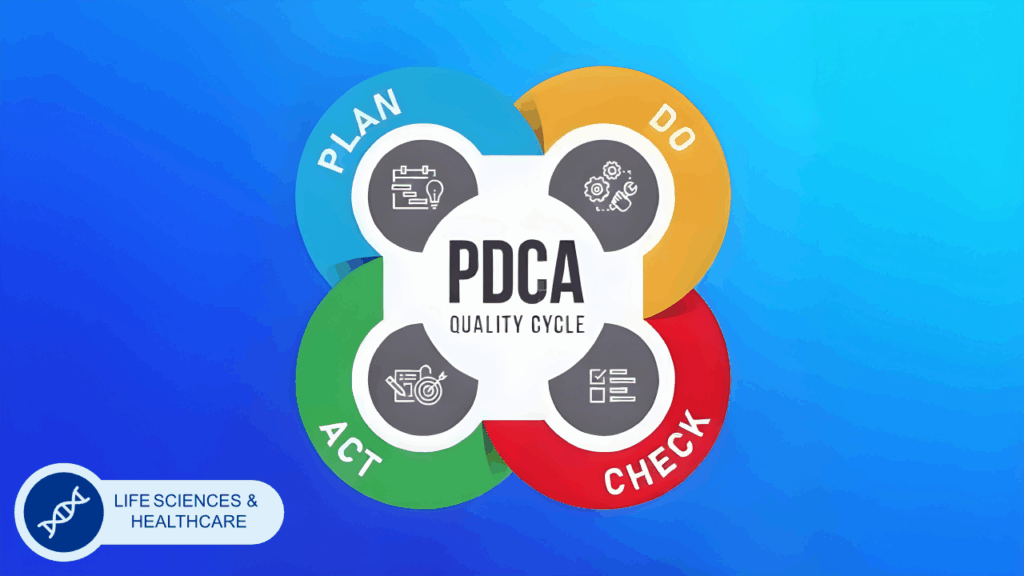
An iterative technique called PDCA (Plan-Do-Check-Act/Plan-Do-Check-adjust) is used to continuously improve people, goods, and services. It is sometimes referred to as the wheel, the Shewhart cycle, the Deming cycle, or the control circle. Process and product control, as well as continuous improvement, are its main applications in business. It turned into a crucial component of lean management.

PLAN PHASE
The current situation is evaluated and analyzed as part of the “Plan” process. Opportunities for improvement are identified and prioritized once all potential and underlying reasons have been identified. Subsequently, system modifications and improvement-related goals are suggested and planned.
DO PHASE
In the Do phase, the preceding stage’s action plan is implemented, typically on a small or pilot size to gather data for analysis and study. Information is gathered to support the next step, which evaluates the idea’s effectiveness before and after, and every change is tried.
CHECK PHASE
The “Check/Study” process entails evaluating the outcomes of the modifications, drawing conclusions from the lessons implemented, and comparing the results with the goals stated in order to determine whether the solutions produced satisfactory results. In essence, the check step is crucial for making decisions and determining the next course of action.
ACT PHASE
During the Act phase, the team documents the results and makes a decision regarding the acceptance or rejection of the adjustments. Keep in mind that because PDCA is used for continuous improvement, it is not a start-end process. During the Act phase, another tactic to identify an even better approach should be implemented.

APPLICATION
A recurring four-stage paradigm for ongoing quality management development is the Plan-Do-Check-Act (PDCA) cycle.
It can be used to standardize nursing care which will enhance nursing quality and raise patient survival rates. It is rarely employed for critical value optimization management; instead, it is primarily utilized for medication administration, patient care, and medical record management. It can be also employed in antibiotic stewardship programs and inventory control.
HOW TO USE:
PLAN: To enhance outcomes, design or modify business process elements. DO: Carry out the plan and assess its effectiveness.
CHECK: Evaluate the measurements and inform decision-makers of the findings. ACT: Choose the modifications required to enhance the procedure.
CONCLUSION
The application of 5’S has greatly aided this business in cutting labor and time. However, our goal is to raise this industry’s performance to a world-class level while meeting client demands at the same time. And all of the Pillars of Total Productive Maintenance will be used to make it happen. After implementation, we hope to achieve our objectives in this industry. For this industry, implementing the 5’S is a smart concept. Following implementation in this industry, we obtain the actual alterations in this. It provides a roadmap for implementing the 5’s with the use of the PDCA Cycle. When all five S’s are applied in this industry, we observe that various areas of the industry are gradually getting better.